

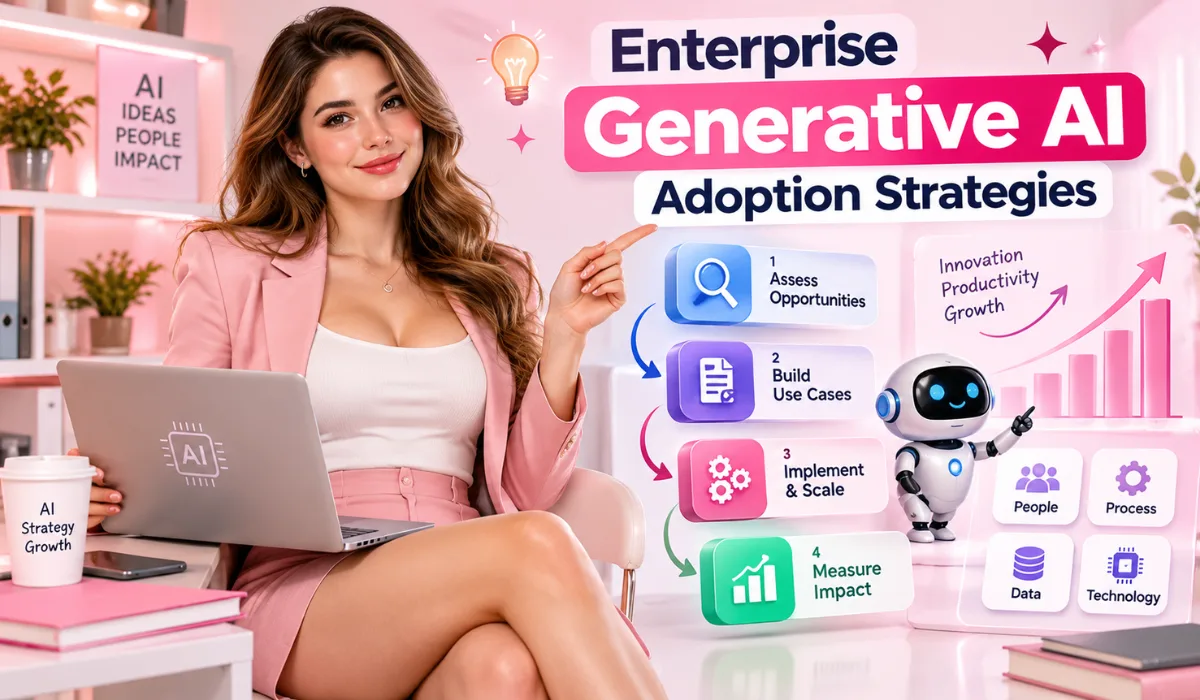
Enterprise Generative AI Adoption Strategies: A Complete 2026 Guide
Artificial intelligence is changing the way the world works. Big companies—known as enterprises—are rushing to use smart computer programs. These programs can write text, draw pictures, code software, and solve tricky business problems in seconds. However, jumping into AI without a plan can cause big messy problems. That is why smart leaders rely on Enterprise Generative AI Adoption Strategies. These strategies act like a trusty treasure map. They guide a massive company safely from old ways of working into a shiny, tech-powered future. Whether you run a giant store, a bank, or a hospital, knowing how to bring AI into your team changes everything. Let us dive deep and look at how big businesses can use AI the right way, keep their data safe, and help their workers thrive.
What are the best enterprise generative AI adoption strategies?
Finding the right game plan is the first big step for any company. You cannot just buy the flashiest computer program and hope for the best. You need a clear roadmap that fits your company's unique goals. The best plans start with understanding what your business actually needs. Do you want to answer customer emails faster? Do you want to write reports in half the time? Once you know your goals, you can pick the right tools. Experts suggest starting small before going big. Test the waters with a single team, see how the tools work, and fix any bugs. After that, you can roll out the technology to the rest of the company.
"Bringing AI into a large company is not just an IT project. It is a total culture shift that requires clear rules, patient training, and strong leadership." — Dr. Elena Vance, Enterprise AI Researcher
Read Also: Enterprise SaaS Solutions For Businesses: Ultimate Growth Guide 2026
Top 10 Enterprise Generative AI Adoption Strategies

If you want a quick checklist of what works best, here are the ten key steps that top-performing companies follow:
- Set clear business goals before buying any software.
- Build a cross-functional AI team with members from tech, legal, and human resources.
- Choose secure platforms that protect company secrets.
- Start with pilot projects in friendly departments like marketing or customer support.
- Train every employee so nobody feels left behind.
- Establish ethical guidelines to keep the AI fair and honest.
- Track performance metrics to see if the AI is actually helping.
- Update security protocols regularly to stop hackers.
- Encourage employee feedback to spot problems early.
- Scale up slowly once the pilot program proves successful.
Generative AI business strategy development and Goal Setting
Building a solid plan takes time and care. Generative AI business strategy development means looking at your company’s long-term dreams and matching them with smart technology. First, look at where your team wastes the most time. Are workers spending hours copying data from spreadsheets? AI can do that in seconds. By targeting these boring, repetitive tasks, you free up your human workers to do creative, fun problem-solving.
Next, set measurable targets. Do not just say, "We want to use AI." Say, "We want AI to cut customer service wait times by thirty percent in six months." Clear goals make it easy to see if your plan is working.
Why is generative AI adoption important for enterprises?
You might wonder why big companies care so much about this tech. The truth is simple: if you stand still, your competitors will zoom past you. Generative AI helps companies work faster, smarter, and cheaper. It acts like an extra brain for every worker. It can suggest new product ideas, write code, and summarize long legal documents in a blink.
Furthermore, customers today expect fast, personalized service. AI helps companies talk to thousands of customers at once while making each person feel special. Without these modern tools, big businesses quickly fall behind nimble startup companies.
Driving AI-driven business process transformation
Change can feel scary, but it is necessary for survival. AI-driven business process transformation means completely redesigning how work gets done from the ground up. Instead of old, clunky paper forms and endless email chains, companies move to smart, connected workflows. For example, when a customer places an order, AI instantly checks inventory, updates accounting records, notifies the shipping department, and sends a thank-you note. This total makeover saves money and prevents human mistakes. Workers stop feeling stressed by paperwork and start focusing on big-picture strategy.
Boosting Efficiency Through AI-powered enterprise workflow automation
Time is money in the corporate world. AI-powered enterprise workflow automation takes boring, repetitive tasks off human shoulders and hands them to smart computer bots. Imagine never having to manually type invoice data into a database again. AI reads the invoice, extracts the numbers, and files it away perfectly. This keeps projects moving 24 hours a day, 7 days a week. It speeds up production and lets your human employees go home on time.
Read Also: What is Enterprise Business Process Optimization: A Complete Guide
Choosing the Right Tools: Generative AI platform selection for enterprises

With hundreds of AI tools on the market, picking the right one feels like finding a needle in a haystack. Generative AI platform selection for enterprises requires a careful checklist.
You must ask important questions before signing any contracts:
- Does this platform protect our private company data?
- Can it handle thousands of users at the same time?
- Is it easy for non-tech workers to learn?
- Does it fit smoothly with our existing computer systems?
Testing a few different options side-by-side helps you see which platform feels right for your team. Never rush this step, because changing AI platforms later can be expensive and frustrating.
Securing Your Data: Enterprise data privacy for generative AI
When you feed company secrets into an AI model, you need to know where that data goes. Enterprise data privacy for generative AI is one of the most important topics in business today. You do not want your customer lists, financial records, or secret product designs leaking out to the public internet. Smart companies use private, secure AI models that live inside their own secure cloud networks. Setting strict rules about what data employees can share with public AI tools keeps corporate information safe from cyber thieves and prying eyes.
Organizing Information: Enterprise knowledge management with generative AI
Big companies generate mountains of documents, emails, and reports every single day. Finding an old file can feel like searching for a lost toy in a giant attic. Enterprise knowledge management with generative AI solves this headache. Smart AI tools read all your company documents and build a giant, searchable brain. When an employee asks, "What was our safety rule for warehouse lifts?", the AI instantly finds the exact paragraph in a fifty-page handbook and gives a clear answer. This saves hours of wasted searching.
Staying Safe and Fair: Responsible generative AI implementation and Best Practices
Power comes with responsibility. AI programs sometimes make mistakes or repeat bad human habits. That is why Responsible generative AI implementation is vital for protecting your brand's reputation. Companies must check AI outputs for bias, fairness, and accuracy. You should always keep a human in the loop to review important decisions made by computer programs.
Following Enterprise AI implementation best practices
To keep your AI projects running smoothly, stick to proven industry guidelines. Enterprise AI implementation best practices include:
- Keeping transparent logs of how AI makes decisions.
- Training staff regularly on ethical AI use.
- Testing software frequently for safety flaws.
- Listening to employee and customer feedback.
Following these rules keeps your company out of legal trouble and builds deep trust with your customers.
How can enterprises overcome generative AI adoption challenges?

No big change happens without a few bumps in the road. Companies often face tech glitches, budget limits, and worried employees who fear losing their jobs to robots.
How can enterprises overcome generative AI adoption challenges? The secret is open communication and steady training.
Show your team that AI is here to help them, not replace them. When workers realize AI takes away the boring parts of their job, they get excited to learn new skills.
Tackling Enterprise AI adoption challenges and solutions
Let us look at common roadblocks and how smart leaders fix them:
| Challenge | Why It Happens | The Smart Solution |
| Employee Fear | Workers worry robots will take their jobs. | Teach staff how to use AI as a helpful assistant. |
| Data Leaks | Workers paste secrets into public AI apps. | Provide secure, company-approved private AI tools. |
| High Costs | AI software and servers get expensive. | Start small with high-return pilot projects first. |
Read Also: Enterprise Big Data Solutions For Analytics: 2026 Guide
Measuring Success: AI adoption metrics for enterprise organizations
How do you know if your AI investment was worth the money? You have to track your progress using clear numbers.
AI adoption metrics for enterprise organizations help you measure success. Useful things to track include:
- How many hours employees save each week.
- How much faster customer questions get resolved.
- The drop in operational error rates.
- Employee satisfaction scores with the new tools.
Reviewing these numbers every month lets you tweak your strategy and get the biggest return on your investment.
Frequently Asked Questions
What is the main goal of enterprise generative AI adoption strategies?
The main goal is to safely and efficiently bring artificial intelligence into a large company to boost productivity, save money, and improve customer service without risking data privacy.
Why do employees sometimes resist AI adoption?
Employees often worry that AI will replace their jobs or make their daily routines too complicated. Clear training and open communication help ease these fears.
How long does it take to roll out AI in a large company?
A full rollout can take anywhere from six months to a few years, depending on the size of the company and how complex their existing computer systems are.
Is enterprise AI safe for confidential data?
Yes, as long as companies use private, secure AI platforms that do not share or store sensitive data on public servers.